
The Next Competitive Advantage Is Your Knowledge Footprint
For the past two decades, businesses have invested heavily in making themselves discoverable online. They built websites, published articles, optimized for search engines, and competed for higher rankings on Google. The underlying assumption was straightforward: if people could find you when they were searching for something relevant, you had an opportunity to earn their attention and eventually their business.
AI is changing that dynamic. As people increasingly use AI to research products, learn about industries, compare companies, and answer complex questions, visibility depends on more than whether your website can be found. It also depends on whether enough credible, consistent information exists for an AI system to understand who you are, what you know, and why your expertise should be considered trustworthy.
This adds a new dimension to digital presence: understandability and proof.
I've started thinking about the body of information that creates this understanding as a company's knowledge footprint.
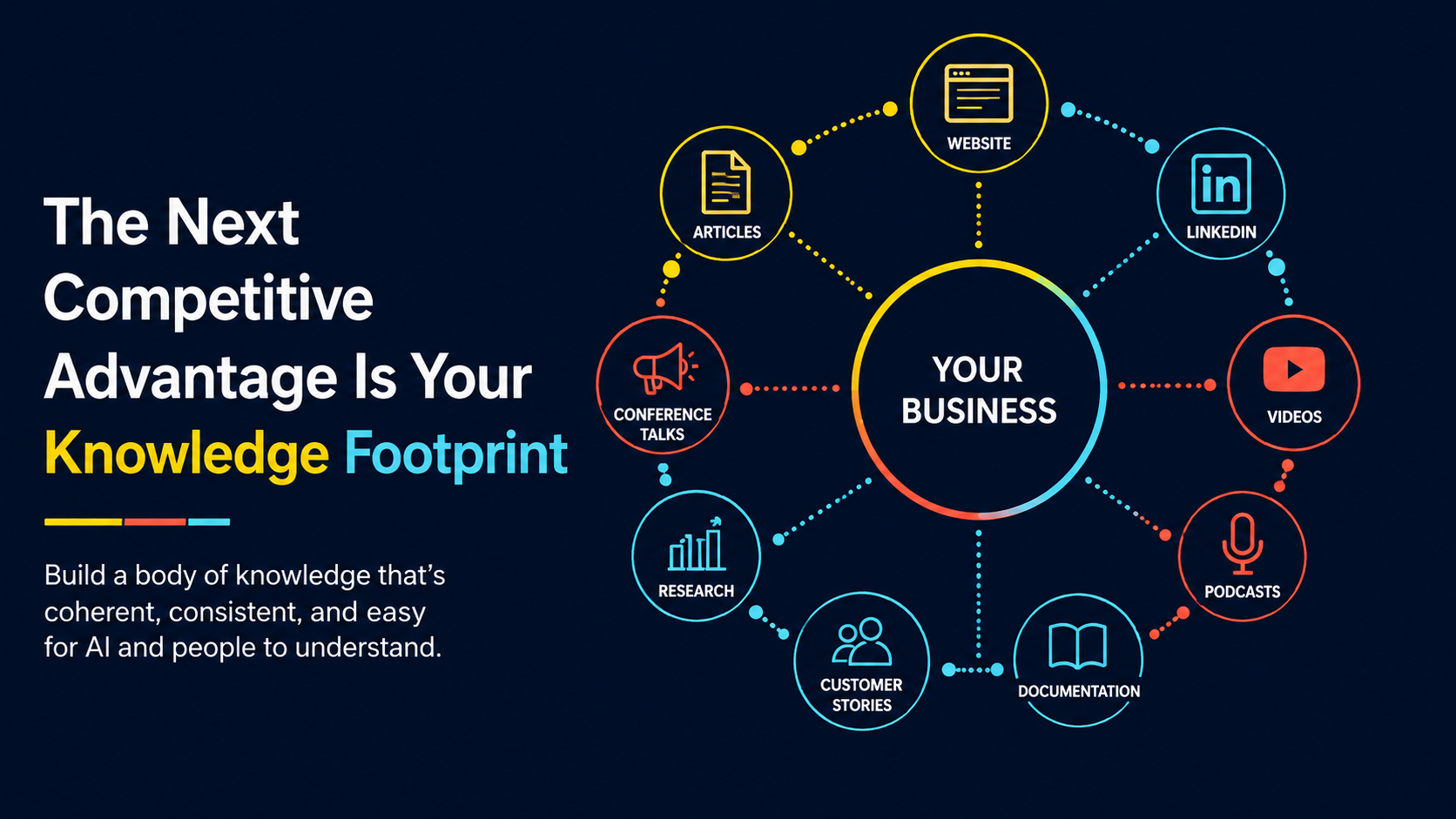
A knowledge footprint is the accumulated expertise a business leaves across the internet. It includes its website, articles, videos, podcasts, documentation, customer stories, research, conference talks, interviews, newsletters, and other places where its knowledge is expressed. Each contributes a different piece of context, and together they create a much more complete picture of what a company knows than any individual webpage could.
The scale of the shift toward AI-mediated discovery is already significant. Google says AI Overviews now reach more than 2.5 billion monthly users, while research into AI-generated search results has found that these answers frequently synthesize information from multiple sources. Studies have also found meaningful differences between the pages surfaced through traditional search rankings and those selected as citations in AI-generated answers. As these behaviors become more common, companies will increasingly need to consider how their expertise is understood across the broader internet rather than focusing exclusively on the ranking of individual pages.
Think about how an AI system encounters a business. It doesn't sit through a sales presentation or experience a brand campaign from beginning to end. Its understanding is assembled from the information available to it: an article explaining an important idea, documentation demonstrating technical depth, a customer story providing evidence that the product works, research establishing expertise, an interview revealing the founder's perspective, or a video explaining a difficult concept clearly.
The stronger and more consistent that evidence becomes, the clearer the picture of the company becomes.
This has implications for how businesses think about platforms and formats. The conversation often centers on whether a company should invest in LinkedIn, YouTube, podcasts, blogs, Instagram, TikTok, or some combination of them. A more useful question is what each platform contributes to the company's broader body of knowledge.
Different formats can reveal different dimensions of expertise. An article can develop an argument in depth, while a video can demonstrate something that is difficult to explain in writing. A podcast can capture nuance and perspective, documentation can demonstrate practical expertise, research can establish authority, and customer stories can provide evidence that the company's ideas translate into results.
The real opportunity comes when these pieces are connected. An article might introduce an idea that a founder later explores in a podcast. A customer story can show that idea working in practice, while a video makes it accessible to a broader audience and documentation explains how it is implemented. Each piece adds something new while reinforcing the same underlying expertise.
This is where content strategy becomes much more interesting than simply increasing publishing frequency. The objective is to build a coherent body of knowledge in which ideas are developed, expanded, demonstrated, and validated across different formats and over time. The more coherent that body of work becomes, the easier it is for someone encountering the company from any direction to understand what it knows and why that knowledge deserves attention.
AI isn't rewarding the companies that publish the most. It's rewarding the companies whose knowledge is easiest to reconstruct.
Publishing hundreds of disconnected pieces creates a very different knowledge footprint from building a body of work in which the same areas of expertise are consistently supported by explanations, examples, research, and proof. The value of a knowledge footprint comes from its coherence: how clearly the pieces reinforce one another and how much evidence they collectively provide.
This doesn't mean every business should immediately expand to every platform. For a company that is just getting started, spreading limited resources across multiple channels can make it harder to build depth anywhere. Start with the platforms where your audience already spends time, establish a consistent point of view, and build from there. As your body of knowledge grows, strong ideas can naturally expand into additional formats and channels, allowing your knowledge footprint to develop deliberately over time.
If you're just starting out and deciding which platforms deserve your attention first, read our guide, How to Choose the Right Social Platform for Your Business.
There is also a compounding effect that I think businesses underestimate. A strong article published today can provide the foundation for a video months later. A customer implementation can add proof to an idea the company has discussed for years. New research can strengthen an existing point of view. As these pieces accumulate, the company's expertise becomes deeper, more connected, and increasingly difficult for a competitor to reproduce.
That is what makes a knowledge footprint a potential competitive advantage. Products evolve, features become easier to replicate, and technology moves quickly. A coherent body of expertise built through years of ideas, evidence, customer experiences, research, and explanation takes considerably longer to build.
For years, companies invested in making their websites easier to discover, and more recently they invested in building audiences across social platforms. AI introduces another layer to that evolution. Businesses now have an opportunity to build a digital presence that makes their expertise both discoverable and understandable, supported by enough consistent evidence for people and AI systems to know what they stand for.
I believe the companies that do this well will build something increasingly valuable: a knowledge footprint that grows richer with every contribution and strengthens the association between their business and the expertise they want to own.
Did you enjoy this post? If so, follow OnVibe on social media, where we share more insights from both our internal and industry research.